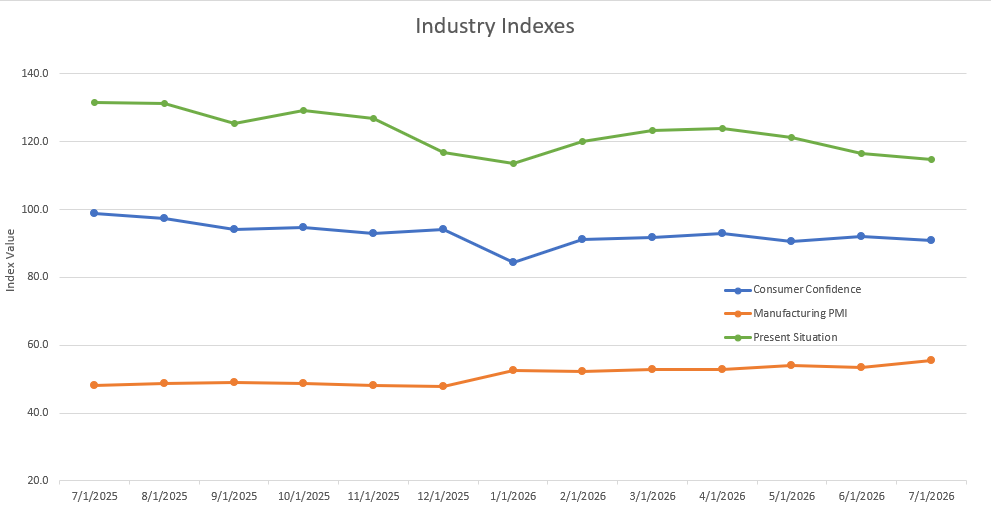
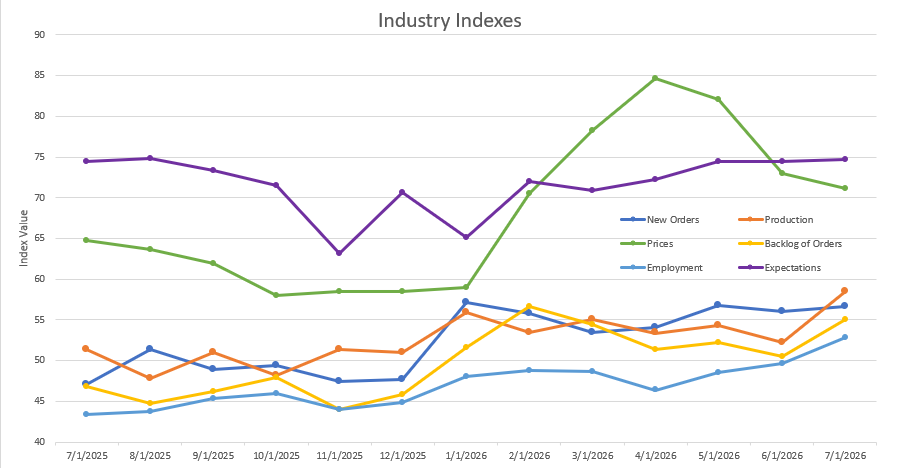
Economic activity in the manufacturing sector expanded in July for the seventh consecutive month, say the nation’s supply executives in the latest ISM® Manufacturing PMI® Report.
The Manufacturing PMI® registered 55.6 percent in July, 2.3 percentage points above the June figure and the highest reading since May 2022 (55.9 percent). The overall economy continued in expansion for the 21st month in a row. (Important data point reference: A Manufacturing PMI reading above 50 percent indicates that the manufacturing economy is generally expanding; below 50 percent indicates that it is generally declining. A Manufacturing PMI above 42.5 percent, over a period of time, indicates that the overall economy, or gross domestic product (GDP), is generally expanding; below 42.5 percent, it is generally declining. The distance from 50 percent or 42.5 percent is indicative of the extent of the expansion or decline.)
The Conference Board Consumer Confidence Index® decreased by 1.4 points to 90.8 in July, down from an upwardly revised 92.2 in June.
Please see the graphs for other notable indexes related to our industry.
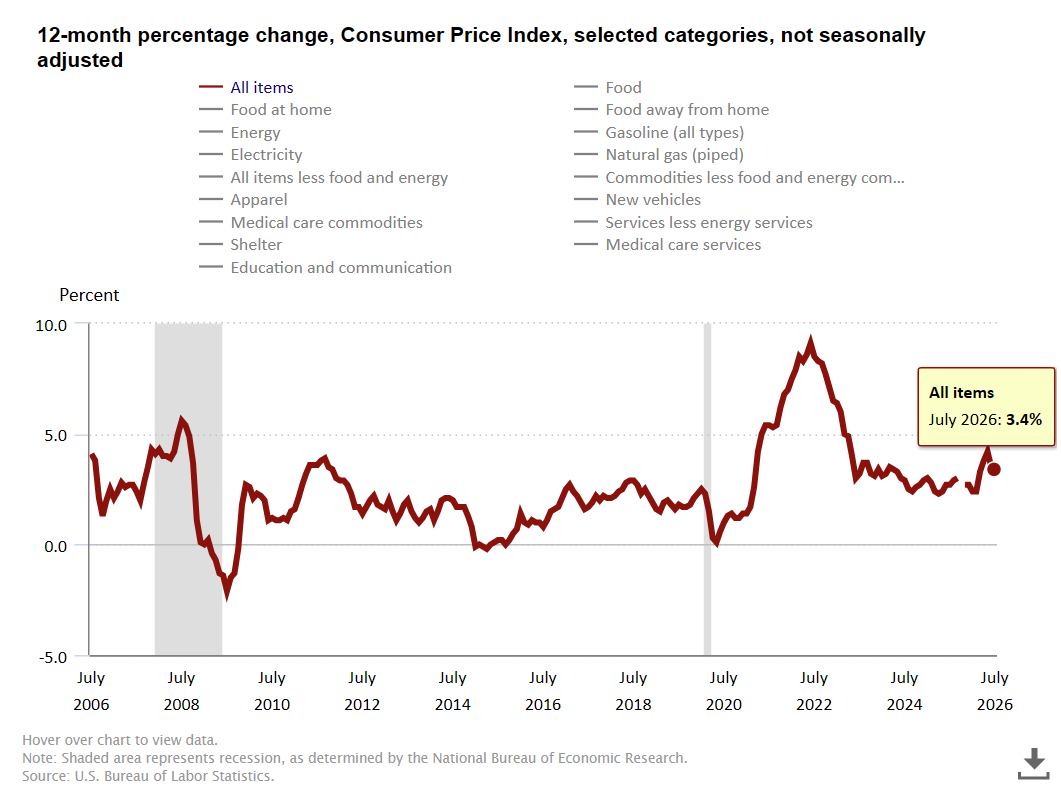
The Consumer Price Index (CPI, otherwise known as our “inflation” friend) is currently at 3.4% in July 2026, down from 3.5% in June 2026 and 4.2% in May 2026. CPI tracks the rate of change in US inflation over time, and the following shows the trends over the past 20 years.
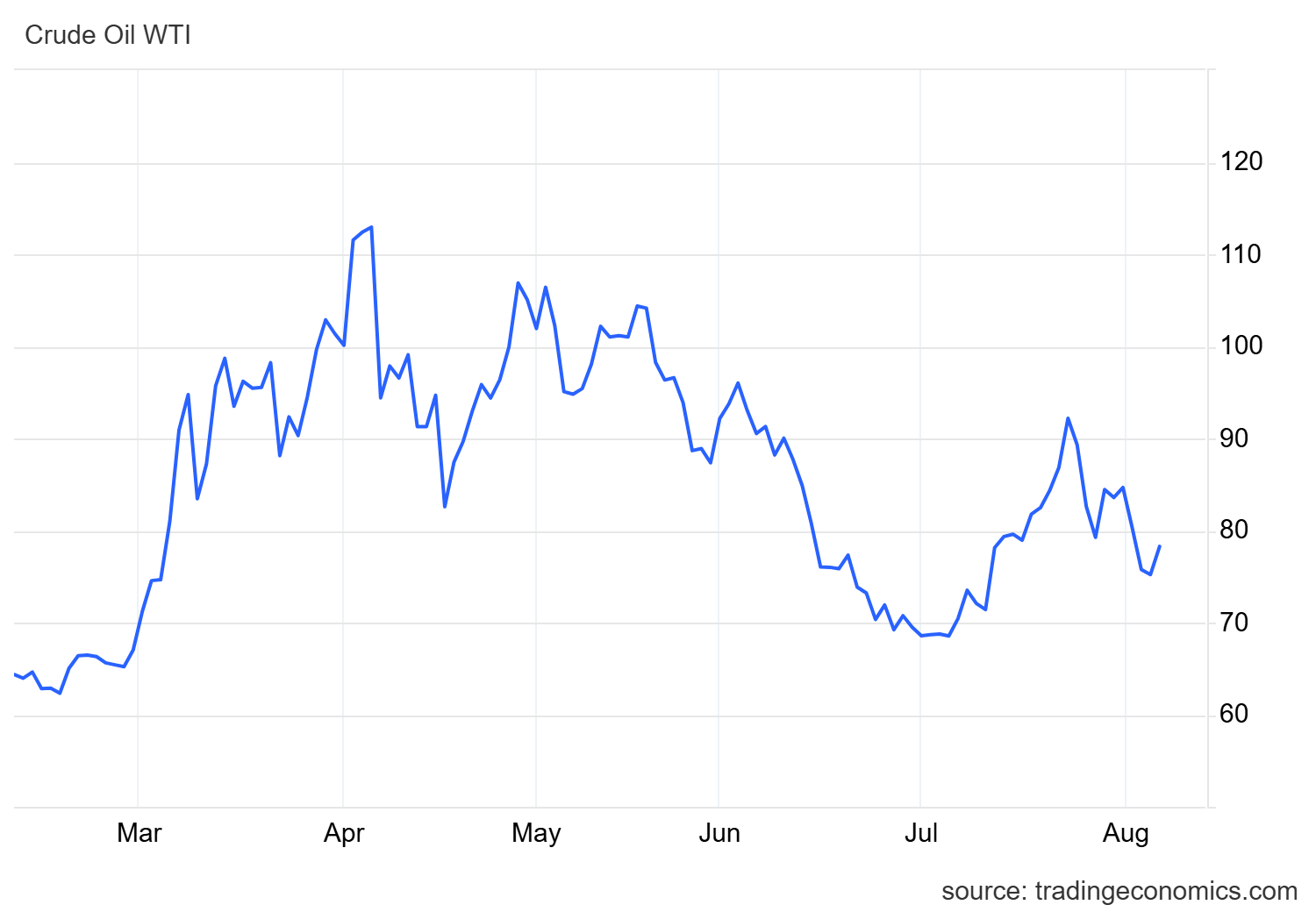
Crude oil extended its gains, rising 3% to $77.5 per barrel on Thursday, after reports that an Iranian parliamentary committee is analyzing a draft proposal outlining restrictive conditions for ship traffic through the Strait of Hormuz. Under the proposal, Iran would prohibit US and Israeli vessels from transiting Hormuz and require countries deemed hostile to pay compensation before being granted passage. Tehran also proposed imposing penalties on violators equivalent to 20% of the value of the cargo carried by a vessel and stated that a full reopening of the strait would depend on the lifting of the US maritime blockade. Meanwhile, Houthi forces in Yemen claimed on Thursday to have launched attacks on Saudi troop positions, adding to geopolitical concerns across the region. Earlier in the day, US officials reiterated their confidence that a nuclear agreement with Iran was within reach, although investors remained cautious about the prospects for a durable and lasting peace.
The online US Oil Rig Count is currently reported as 588, which is up 8 compared to last month’s report and up 48 from August 01, 2025. This key and leading indicator shows the current demand for products used in drilling, completing, producing, and processing hydrocarbons, which we all use every day as fuel sources and finished products.
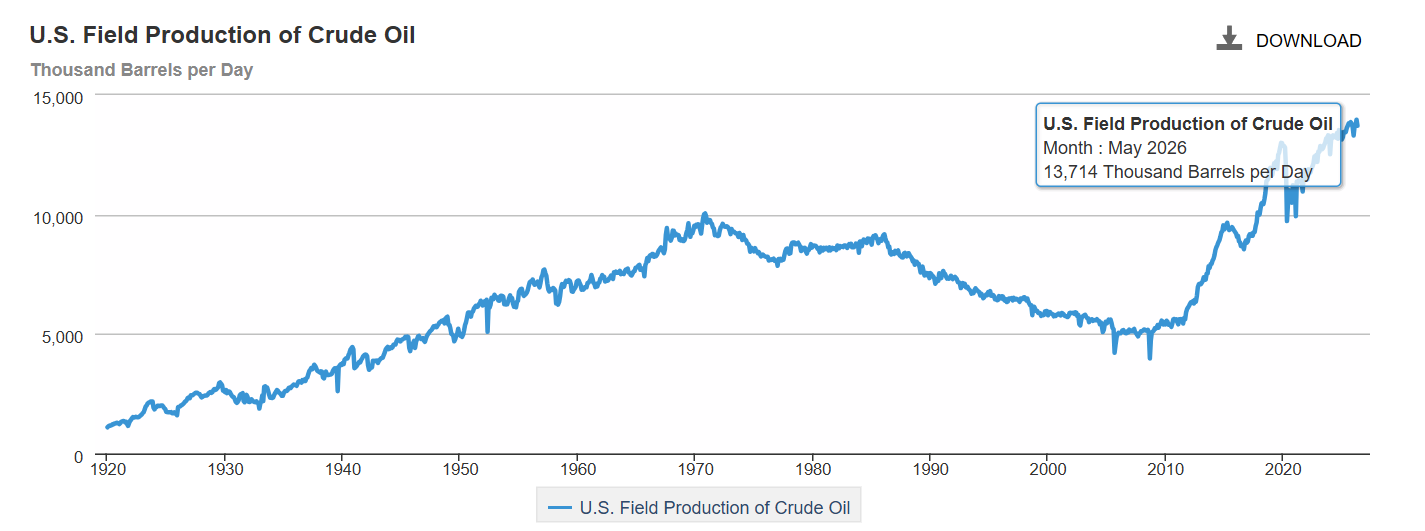
The number of rigs conducting oil and gas drilling in the United States remains stagnant, but efficiency has increased significantly over the years, as shown in the chart below. We are drilling at or near record production levels. However, this trend of fewer rigs still reflects the priority of drillers to focus on efficiency and enhancing shareholder returns rather than expanding production through capital investments due to the previous administration’s desire to move away from fossil fuels. This philosophy might change now that the Trump administration is entirely behind fossil fuels. To provide context, in 2019, 954 rigs were drilling for oil and gas in the US, and, in 2014, there were 1609 rigs before oil prices dropped below $20 per barrel at the end of that year.
Tariffs have tightened, untightened, and will continue to evolve as the Trump administration navigates global negotiations.
Whew… There’s still A LOT to unpack here, so hold on for the roller coaster ride.
A little background on where all of this started and what it means. Tariffs are duties placed on foreign goods, paid by domestic importers to Customs and Border Protection at ports of entry. President Trump introduced tariffs on select Chinese goods in his first term back in 2018, which President Joe Biden later maintained, along with duties on steel and aluminum from most countries. In February of 2025, Trump reinstated tariffs—10% more on Chinese imports, bringing them to 35%, and 25% on Mexican and Canadian goods (except for oil, taxed at 10%). From there, it has been an ever-changing environment, with tariffs fluctuating month to month based on negotiations with other nations.
Tariff Update for August 2026
The tariff landscape has reached a transition point. Here is where things stand and what it means for you.
Section 122 Is Gone
Section 122 expired July 24th by statute. Congress did not act to extend it and the president cannot extend it unilaterally. That chapter is closed. The administration has spent the last several months engineering its replacement, and that replacement is now taking shape.
What Comes Next… The Section 301 Bridge
This is the most important development from last month. The Office of the United States Trade Representative (USTR) proposed additional tariffs on imports from 60 economies under Section 301 of the Trade Act of 1974, grounded in a forced labor investigation. Proposed rates run from 10% to 12.5% depending on the country. The public comment period closed July 6th, and public hearings ran July 7th through July 9th. The new tariffs went into place right after the Section 122 tariffs expired.
Unlike IEEPA, which the Supreme Court struck down in February, Section 301 tariffs carry no expiry date, no rate cap, and a legal track record that has survived more than 4,000 court challenges since 1974. The administration found its durable legal ground. This is the framework your customers should be planning around going forward.
The rates are not yet final. USTR may modify, finalize, or decline to adopt the proposed action after the hearings. We will update you as soon as final rates are announced.
What Has Not Changed… Section 232 Stands
None of the above pertains to Section 232, which governs tariffs on steel, aluminum, and copper. It was written specifically to authorize tariff action on national security grounds. It has survived every legal challenge to date and remains fully in effect.
The April 6th framework remains the operative structure:
- Raw mill products, plate, sheet, tube, pipe, and fittings at 50% on the full customs value.
- Derivative articles substantially made of steel, aluminum, or copper at 25% on full customs value.
- Certain metal-intensive industrial equipment at a temporary 15% through December 31, 2027.
- Products made with 100% U.S.-origin metal at 10%.
- Products with 15% or less metal content by weight are not subject to Section 232 tariffs.
One important note on how Section 301 and Section 232 interact. For most trade partner countries subject to the new forced labor investigation, the proposed Section 301 tariffs at 10% to 12.5% would not stack on top of Section 232 tariffs. Our raw material inputs already covered under Section 232 would not be double-hit from those countries. For China and other bad actors, however, the picture is different. Existing Section 301 tariffs from 2018 remain fully in place at 7.5% to 25% depending on the product, and those do stack with Section 232. A Chinese-origin steel product in 2026 can face the base MFN rate plus 25% Section 301 plus 50% Section 232, putting the combined effective rate well above 75% before any anti-dumping or countervailing duties are even applied. The new forced labor investigation tariffs would be a separate additional layer on top of all of that for Chinese goods. If any portion of your supply chain has Chinese content, that exposure is real and worth understanding in detail.
How Does This Affect Imported Pressure Vessels and Heat Exchangers?
Per our understanding, pressure vessels and heat exchangers are fabricated equipment classified under HTS Chapter 84 (industrial machinery), not Chapters 72 through 76 (raw steel mill products). This distinction matters significantly under the April 6th Section 232 overhaul.
For aluminum heat exchangers, the picture is clear. HTS subheadings 8419.50.10 and 8419.50.50 are explicitly listed as aluminum derivative articles in the April 6th proclamation, meaning imported finished aluminum heat exchangers are subject to a 25% tariff on the full customs value of the unit, not just the metal content. On a $500,000 imported aluminum heat exchanger, the tariff base is the full $500,000.
For stainless steel, alloy, and carbon steel heat exchangers, and for pressure vessels of any material, the situation is less settled. These products typically classify under HTS 8419.50.50 and 8419.89, respectively, neither of which appears in the steel derivatives section of the April 6th annexes. This creates a genuine gray area. Imported finished steel heat exchangers and pressure vessels may not currently be explicitly covered by the Section 232 derivative tariff on the finished unit. As USTR finalizes the Section 301 exclusion list, we will be watching closely to see how finished pressure equipment is treated.
It is also worth noting what the Annex language does and does not say about tanks and vessels under Chapter 73. Two codes are listed under Annex I-A at the 50% rate. HTS 7309.00.00 covers iron or steel reservoirs, tanks, vats, and similar containers with a capacity exceeding 300 liters, but only those not fitted with mechanical or thermal equipment. HTS 7311.00.00 covers iron or steel containers for compressed or liquefied gas.
While these codes may appear to cover pressure vessels at first glance, the critical limitation in 7309 is that phrase: “not fitted with mechanical or thermal equipment”. A fabricated ASME pressure vessel with nozzles, instrumentation, internals, and process connections would almost certainly not qualify under that language. Neither code uses the word “vessel” at all. A purpose-engineered ASME Code vessel is fundamentally different from a simple storage tank or container. The customs classification of fabricated pressure equipment under Chapter 73 versus Chapter 84 is a fact-specific determination, and Chapter 84 typically governs process equipment of this nature.
What is unambiguous for all product types is that the raw material inputs (i.e. stainless plate, carbon steel plate, seamless and welded tubing, and pipe fittings) are covered at the full 50% rate under Annex I-A, regardless of how the finished equipment is ultimately classified.
One Process Change Worth Noting
The petition-based inclusion process that previously allowed domestic manufacturers and trade associations to formally request that specific HTS codes be added to Section 232 scope has been terminated. Going forward, Commerce and USTR will adjust product coverage on a rolling basis at their own discretion. There is no formal submission window anymore.
As of August 6th, 2026, the Commerce Department’s Bureau of Industry and Security published a Federal Register notice requesting public comments on a proposal to add 14 additional derivative articles to the Section 232 tariff scope. The list includes parts of heat exchange units, parts of welding machines and apparatus, fire extinguishers, parts of certain hydraulic engines and motors, cranes and lifting equipment, tanker trailers, agricultural trailers, filled steel containers, and others.
Most of the proposed products would be subject to a 25% tariff if included. Comments are due 21 days after the August 6 Federal Register publication. Therefore, the comment deadline is August 27, 2026.
That means if you believe imported finished pressure vessels and heat exchangers should be explicitly covered under Section 232 derivative tariffs, the path forward is direct engagement with your elected officials. Not a petition. A phone call. A meeting. A letter.
As pressure vessel and heat exchanger fabricators, we need to continue pushing for protection to be in place for manufacturers of steel products, not just for domestic suppliers of raw material. We encourage every customer and partner in this industry to make that contact.
What This Means for Ward
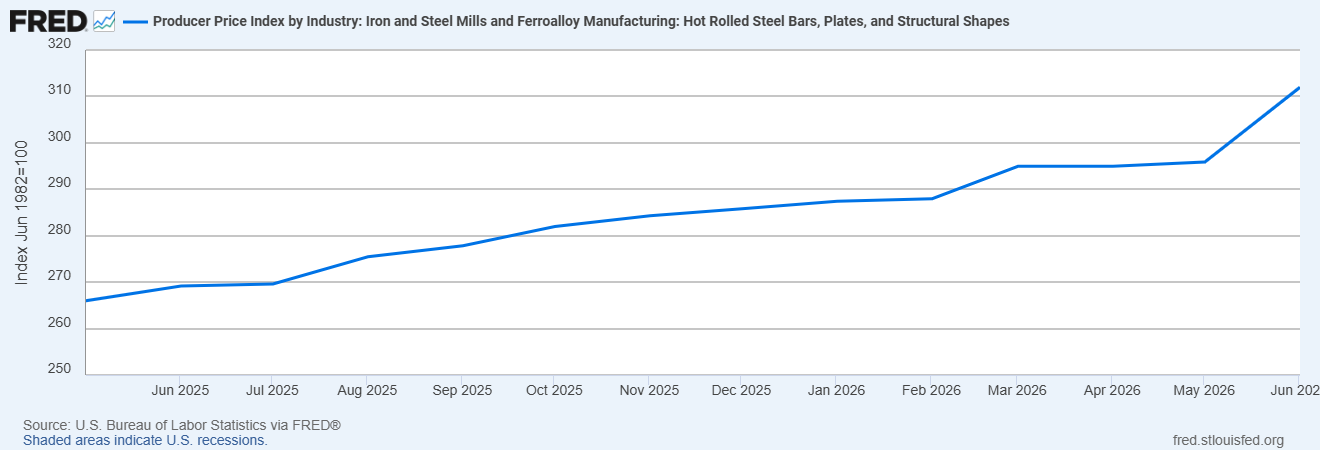
Nothing changes in our cost structure today. We purchase 80 to 90 percent of our material domestically depending on the project. Our total material spend has increased approximately 10 to 20 percent since Section 232 tariffs were enacted, resulting in a 5 to 15 percent overall unit price increase after labor. We are absorbing what we can. We are passing through what we must.
And we will continue to monitor the evolving situation and update you each month on the latest developments.
The administration has published several tariff fact sheets on the White House website (click here) as the tariff topic has evolved.
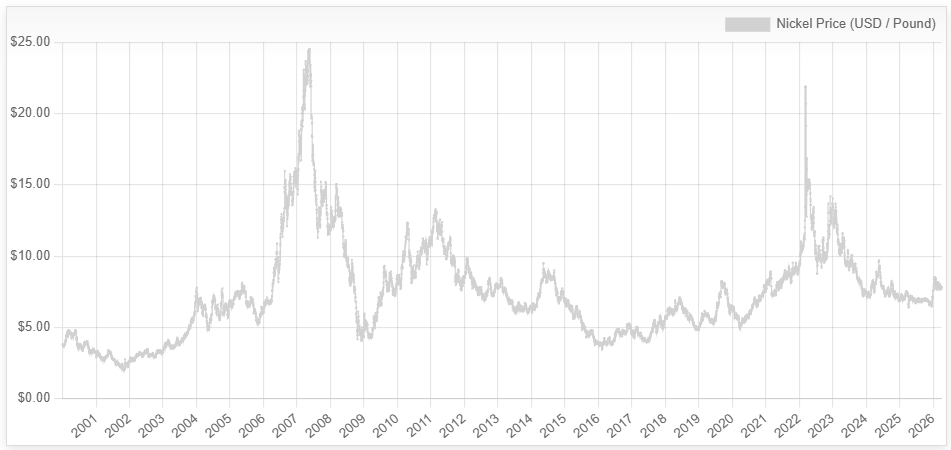
Nickel traded around $7.575 per pound in August, retreating to its lowest level since mid-July as expectations of improved Indonesian supply weighed on prices. The decline followed reports that Indonesia may further relax supplementary RKAB nickel ore quotas, with a major mining player expected to receive additional allocations that would significantly increase its 2026 allocation and support downstream smelter feedstock availability in the second half of the year. Prices also came under pressure as easing concerns over potential disruptions in the Strait of Hormuz reduced sulfur costs, lowering input cost pressures for nickel processing. Meanwhile, expectations that Indonesia will continue to manage nickel ore supply through RKAB quotas, along with elevated production costs, continued to provide some support.
Plate mill plate lead times (weeks):
Domestic:
Stainless & Duplex: 14 to 15 (previously 12 to 13)
Nickel Alloys: 13 to 14 (previously 7 to 12)
Carbon steel: 12 to 30 (previously 13 to 17)
*Keep in mind, some plates will exceed the estimated ranges depending on the mill’s production schedule and slab availability. *
Welded tubing lead times (weeks):
Domestic:
Carbon: 6 to 16 (no change)
Stainless: 8 to 18 (no change)
Nickel Alloy: 8 to 22 (previously 8 to 18)
Import:
Carbon: 14 to 25 (no change)
Stainless: 16 to 30 (no change)
Nickel Alloy: 16 to 42 (no change)
Seamless tubing lead times (weeks):
Domestic:
Carbon: 6 to 26 (no change)
Stainless: 8 to 26 (no change)
Nickel Alloy: 8 to 18 (no change)
*Lead times are accurate if bar is in stock. If not, lead times can increase to 44 weeks as most bars are of foreign melt. *
ASME head lead times (weeks):
Domestic:
Stainless: 6 to 16 (no change)
Nickel Alloys: 6 to 16 (no change)
Carbon steel: 9 to 16 (no change)
*Keep in mind, some heads will fall outside the listed ranges depending on the alloy and size/thickness. Some head vendors stock common sizes (under 72” OD) and alloys, allowing them to ship next day. *
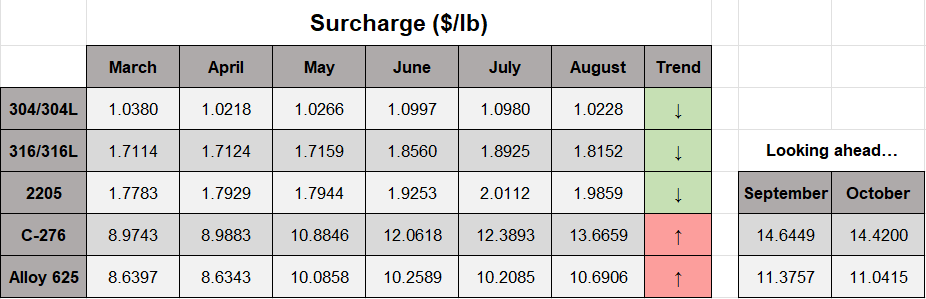
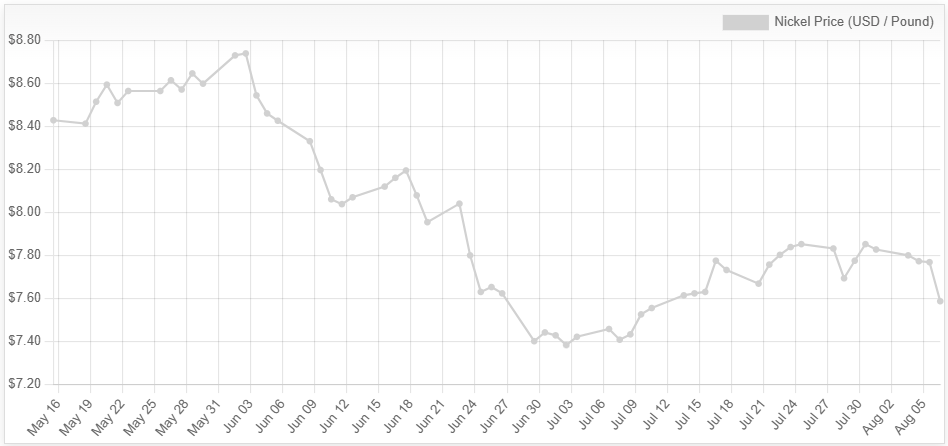
Nickel Prices have had an interesting ride over the past three decades, with a low of $2.20/lb. in October 2001 (following the September 11 events) and a high of $23.72/lb. in May 2007. Surcharges trail Nickel prices by approximately two months, so they would have been at their lowest in December 2001 (304 was $0.0182/lb.) and peak in July 2007 (304 was $2.2839/lb.).