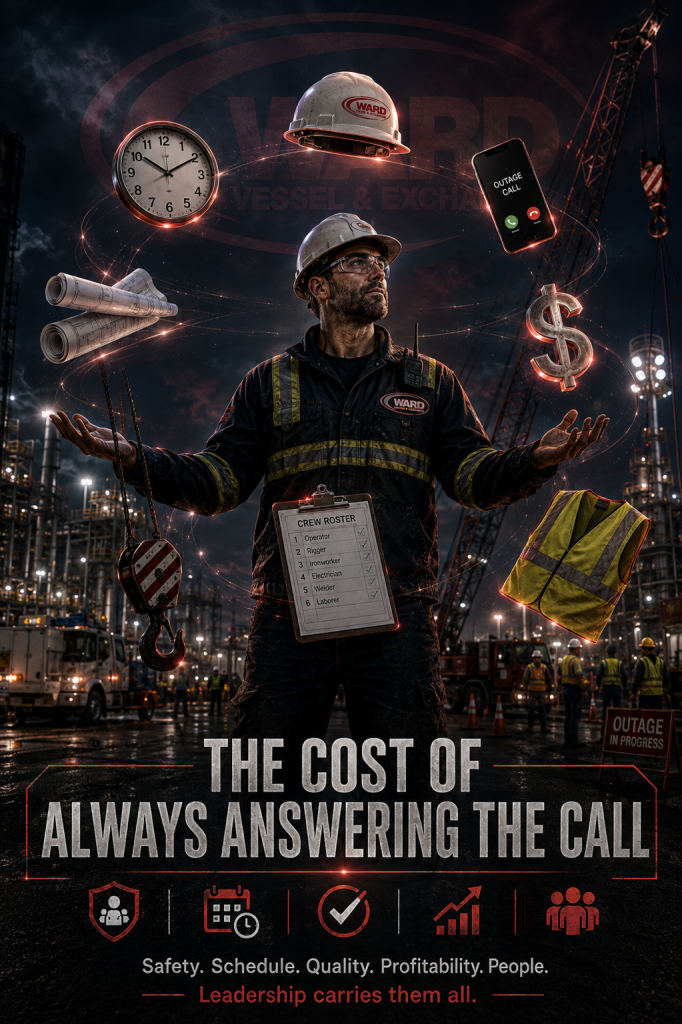
The Cost of Always Answering the Call
Leadership, Fatigue, and Sustainable Excellence in Emergency Industrial Repair and Maintenance
In the industrial repair business, there is a certain pride that comes with answering the call.
A critical heat exchanger fails. A storage tank develops a leak. An outage falls behind schedule. A plant manager picks up the phone, and suddenly an entire organization pivots into action. Crews mobilize, materials are expedited, hotels are booked, equipment is loaded, and before long, people are working around the clock to solve a problem that simply cannot wait.
For the client, that responsiveness is invaluable, and for many of us in this industry, delivering that level of service is a source of genuine pride. For the people responsible for making it happen, however, the reality is often far more complex than most realize.
When discussions about fatigue arise, the focus is typically on the physical demands placed on the craft workforce. That’s appropriate. Long shifts, demanding conditions, and physically strenuous work require constant attention from both contractors and facility owners. Fatigue in the field is a legitimate safety concern and should be treated as such.
But there is another form of fatigue that receives far less attention: the fatigue of leadership.
Field supervisors, operations managers, project managers, and business leaders often operate in a constant state of competing priorities. They’re expected to deliver safe results, maintain schedules, control costs, support their crews, communicate with clients, respond to unforeseen challenges, and ensure the project remains profitable. Most of those responsibilities don’t stop when the shift ends.
Anyone who has managed a critical-path repair has lived some version of the same story. The crane gets delayed. A critical material shipment misses its delivery window. Additional damage is discovered after the equipment is opened. Weather threatens tomorrow’s work plan. The client needs an update. The field crew needs direction. And somewhere between all of it, another phone call (or three…) comes in, usually at the worst possible time.
Leadership fatigue is rarely caused by a single event. It is the accumulation of hundreds of decisions, dozens of interruptions, and the understanding that every choice carries consequences for safety, schedule, customer satisfaction, and financial performance.
That weight follows people home.
It shows up during dinner. In hotel rooms hundreds of miles away from family. In interrupted weekends and late-night phone calls from jobsites. It isn’t unique to one company or one role. It’s simply part of the responsibility that comes with leading emergency and critical-path work.
The industrial services industry has always celebrated people who do whatever it takes to get the job done. In many ways, that’s one of our greatest strengths. The commitment, resilience, and professionalism displayed during outages and emergency repairs are often remarkable. Clients depend on that dedication, and many of the industry’s greatest success stories are built upon it.
The challenge arises when occasional heroics become the standard operating model.
A demanding outage can be managed through extraordinary effort. A difficult turnaround can be pushed across the finish line through determination and teamwork. But long-term organizational success cannot depend on leaders living in a perpetual state of exhaustion.
At some point, fatigue stops being a personal issue and becomes an operational risk.
An exhausted leader making critical decisions after days of interrupted sleep faces many of the same challenges as any other fatigued worker. Focus narrows. Patience shortens. Judgment can suffer. Small details become easier to miss.
And in our business, small details matter.
Clients often see the visible side of a successful repair. They see welders, crane operators, pipefitters, and technicians performing the work that returns critical assets to service. What they don’t always see is the support structure operating behind the scenes: supervisors coordinating manpower, operations teams solving logistical challenges, project leaders developing contingency plans, and managers balancing client expectations against the realities of safety, quality, and execution.
None of this is a complaint. It’s simply the reality of leading in a business where urgency is often part of the job description.
The best organizations recognize that sustainable excellence requires more than hard work. It requires passionate people who care deeply about serving clients and supporting one another. It requires consistent execution, disciplined processes, and leadership depth that prevents critical responsibilities from resting on the shoulders of only a few individuals. And it requires a selfless commitment to the success of the team, recognizing that the best outcomes are rarely achieved alone.
Organizations that thrive over the long term invest in developing leadership capacity throughout their ranks. They cross-train key personnel, create realistic staffing models, establish clear communication channels, and build systems that allow people to perform at their best even when the pressure is at its highest. More importantly, they acknowledge that the people carrying the responsibility are just as important as the projects being delivered.
Emergency repairs will always involve urgency. Critical-path work will always require sacrifice. Clients will always need trusted partners willing to answer the phone when something goes wrong.
That will never change.
What can change is how organizations think about leadership fatigue. The goal isn’t to eliminate hard work, and it certainly isn’t to avoid difficult projects. The goal is to build teams capable of delivering exceptional results year after year without relying on continuous sacrifice from the same individuals.
The best organizations understand that sustainable excellence is not built on heroics alone. It is built by passionate people who care deeply about serving others, consistent systems that support sound decision-making under pressure, and selfless leaders who put the success of the team ahead of personal recognition.
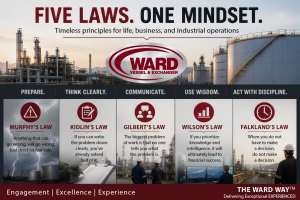
At Ward, we refer to this philosophy as The Ward Way: delivering exceptional experiences through engagement, excellence, and experience. Those exceptional experiences are not created by a single supervisor, project manager, or operations leader carrying the entire burden. They are created when committed people work together, support one another, and build an organization capable of serving clients at a high level for years to come.
Because the most successful repair isn’t simply the one completed on time. It’s the one completed safely, profitably, and in a way that ensures the team is ready to answer the next call.
And the one after that.
That’s how exceptional experiences are delivered. Not just today, but for the long haul.