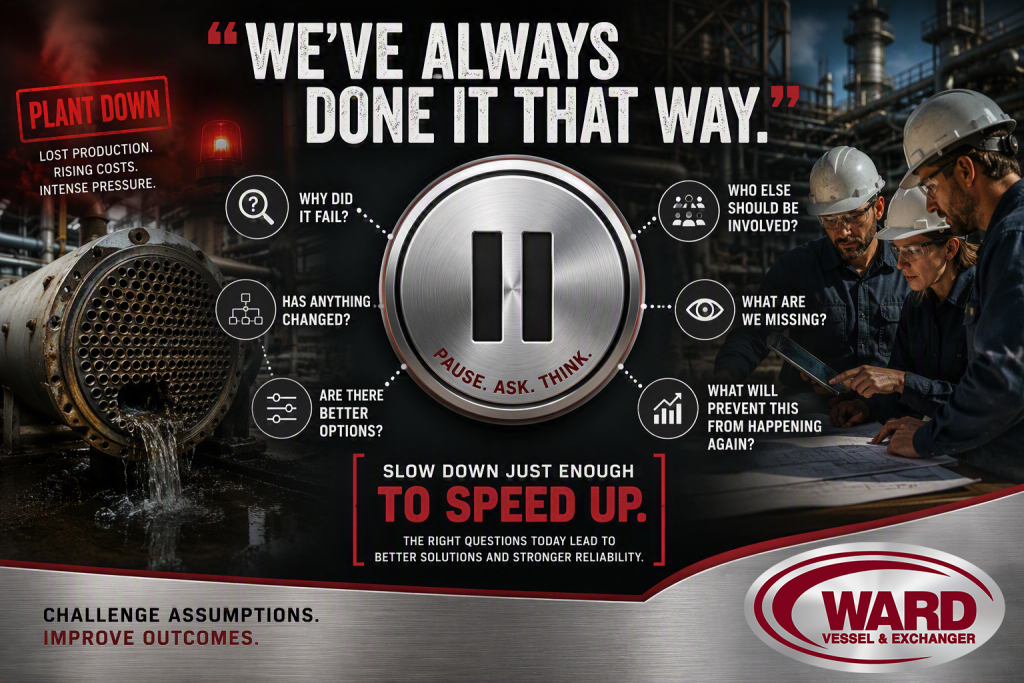
We’ve Always Done It That Way
A heat exchanger fails, and the plant goes down. The maintenance and reliability team is under tremendous business pressure. Every minute counts. Production is impacted, schedules are disrupted, and the priority is clear: get operations back online as quickly as possible.
In situations like this, the instinct is often to reach for the old playbook. Pull the nameplate data, find an old drawing, call the original manufacturer, and order a like-for-like replacement. It’s an understandable reaction. When the pressure is on, familiarity feels safe.
But that is often the exact moment when one simple phrase can quietly cost a company money, opportunity, and long-term reliability: We’ve always done it that way.
To be clear, experience matters. Proven solutions matter. There are many times when the original design is still the right design and the original vendor is still the best choice.
The danger comes when we stop asking questions.
A failed heat exchanger might be a straightforward replacement. Or it might be signaling a larger issue. Was the original design appropriate for the current operating conditions? Have process conditions changed over time? Has the equipment consistently experienced the same failure mode? Is there an opportunity to improve materials of construction, modify the design, increase reliability, reduce maintenance requirements, or improve performance? In other words, are we solving the problem, or are we simply replacing the evidence?
Root cause analysis is only one example of why challenging assumptions matters. The bigger lesson is that valuable opportunities are frequently overlooked when organizations automatically default to the same vendors, same designs, same procedures, and same decisions they have always used. This applies far beyond a failed heat exchanger.
How many times have we continued using a supplier because that’s who we’ve always purchased from? How many times have we kept a maintenance strategy in place because it has been on the schedule for years? How many times have we accepted a process, a procedure, or even an organizational structure simply because nobody stopped long enough to challenge it?
The most successful facilities we’ve encountered share a common trait. They respect experience without becoming trapped by it. They continuously ask whether today’s conditions still justify yesterday’s decisions. That doesn’t mean changing things for the sake of change. It means remaining curious enough to evaluate alternatives.
At Ward, we are fortunate to work with customers across a wide range of industries and facilities. One advantage of that exposure is seeing different approaches to similar challenges. Sometimes a solution that is common practice at one facility is completely unknown at another. Simply asking a few additional questions can reveal options that were never previously considered. The same principle applies when selecting vendors and project partners. Many companies focus only on the equipment itself. But it can be valuable to ask what additional support a partner can provide. Can they help investigate the failure? Can they assist with field measurements? Can they handle removal and installation? Can they support outage planning? Can they help identify opportunities to improve the overall outcome rather than simply replacing what failed? Sometimes the lowest-risk solution is not the supplier who can provide a piece of equipment. It is the partner who can help solve the broader problem.
We often tell our team that customers compare every experience they have against the best experience they have ever had, regardless of industry. That expectation doesn’t only apply to restaurants, hotels, or companies made famous by exceptional customer service. It applies in industrial manufacturing as well. If we want to deliver exceptional experiences, we cannot be satisfied with automatic answers and habitual decisions. We have to remain willing to challenge assumptions, explore alternatives, and occasionally pause long enough to determine whether there is a better path forward. Sometimes the fastest way to solve a problem is to slow down just enough to ask a better question.
Join the Conversation
What is the best example you have seen of a company breaking away from a We’ve Always Done It That Way mindset and achieving a better outcome?
We’ll post this question on our LinkedIn page later this month and would love to hear your story. So, please be on the lookout for it! The story that generates the most discussion or provides the most valuable lesson will receive a little Ward swag as a thank-you for participating.
After all, some of the best ideas begin when someone is willing to ask: Why are we doing it this way in the first place?