Five Laws That Apply Equally to Life, Business, and Industrial Operations
Every summer offers a chance to step back from the day-to-day demands of projects, turnarounds, schedules, and budgets and reflect on the lessons that consistently prove themselves true.
Whether you’re operating a refinery, managing a chemical plant, overseeing a fabrication and repair business, or simply navigating life, there are a handful of principles that seem to reappear with remarkable consistency. Over the years, we’ve found that the following five “laws” apply just as readily to industrial operations as they do to everyday decision-making.
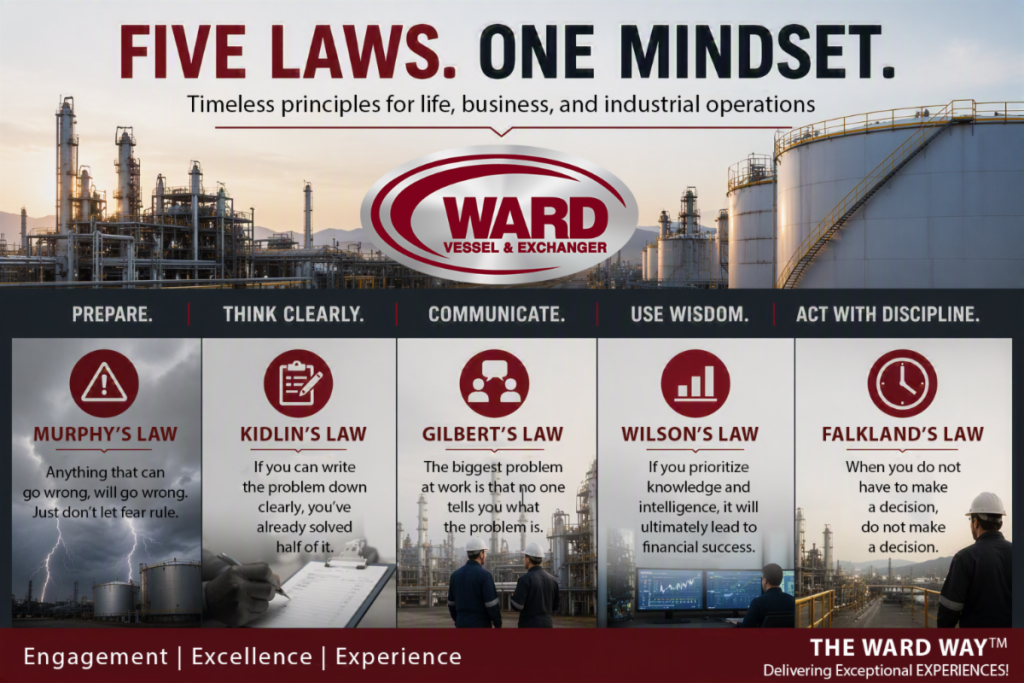
Murphy’s Law – Anything that can go wrong will go wrong; just don’t let fear rule
Murphy’s Law isn’t about pessimism—it’s about preparation.
In our world, this may mean changes to a heat exchanger design after design is complete and fabrication is underway, unexpected findings during a tank repair, or dealing with weather delays during a critical outage. The organizations that consistently succeed aren’t necessarily the luckiest; they’re the ones that plan for the possibility that things won’t go exactly according to plan.
The best projects aren’t built around the assumption that everything will go right. They’re built around the ability to respond effectively when something doesn’t.
Kidlin’s Law – If you can write the problem down clearly, you’ve already solved half of it
Many operational challenges persist because people are addressing symptoms rather than defining the actual problem.
Anyone who has participated in a root-cause analysis understands this concept well. Once the problem is clearly defined, solutions often become surprisingly obvious.
Whether it’s a recurring reliability issue, an inspection finding, a production bottleneck, or a capital project decision, taking the time to accurately articulate the challenge frequently reveals the path forward.
Clarity creates momentum.
Gilbert’s Law – The biggest problem at work is that no one tells you what the problem is
This law may be one of the most relevant to industrial organizations.
Miscommunication is responsible for countless delays, change orders, safety incidents, and strained relationships. Production assumes maintenance understands the priority. Maintenance assumes engineering understands the limitation. Contractors assume expectations have been communicated.
Meanwhile, everyone is solving a different version of the same problem.
The best facilities and project teams create environments where challenges can be identified openly and discussed honestly. Problems rarely improve with age. Most improve rapidly once everyone is looking at the same issue.
Wilson’s Law – If you prioritize knowledge and intelligence, it will ultimately lead to financial success
Companies that invest in learning, training, inspections, data analysis, and continuous improvement consistently outperform those that focus solely on short-term cost reduction. Knowledge allows organizations to make better decisions, identify risks earlier, improve reliability, and avoid costly surprises.
The same principle applies to individuals. The most valuable people in any organization are often those who never stop learning—whether they’re operators, engineers, inspectors, project managers, or executives. As knowledge grows, so does the ability to solve problems, create value, and drive results.
In industrial operations, intelligence isn’t measured by how much information you collect; it’s measured by how effectively you apply what you know. When organizations prioritize knowledge and use it wisely, financial success is often the natural outcome.
Falkland’s Law – When you do not have to make a decision, do not make a decision
At first glance, this seems contradictory to the action-oriented mindset found in most industrial environments.
In reality, Falkland’s Law promotes patience and discipline. Not every issue requires an immediate response. Not every inspection finding requires a replacement. Not every market fluctuation requires a strategic shift.
One of the most valuable skills a leader can develop is knowing when to act and when to wait for additional information.
Making a premature decision can be just as costly as delaying a necessary one.
The Common Thread
What ties these five laws together is their focus on disciplined thinking.
Prepare for uncertainty. Define problems clearly. Communicate openly. Use information wisely. Avoid unnecessary decisions.
These principles won’t eliminate challenges, whether in life or in a refinery, chemical plant, pharmaceutical facility, or manufacturing operation. But they can help organizations respond more effectively when those challenges inevitably appear.
In many ways, these principles also reflect The Ward Way™. Successful field projects aren’t built on the assumption that nothing will go wrong. They’re built on planning for the unexpected, communicating openly when conditions change, making sound decisions based on facts, and working collaboratively to find solutions. Whether we’re repairing a heat exchanger, replacing a storage tank, or supporting a turnaround, our goal remains the same: deliver an unparalleled customer experience by helping customers navigate challenges rather than simply reacting to them.
And, if Murphy’s Law decides to make an appearance tomorrow, at least you’ll be ready.