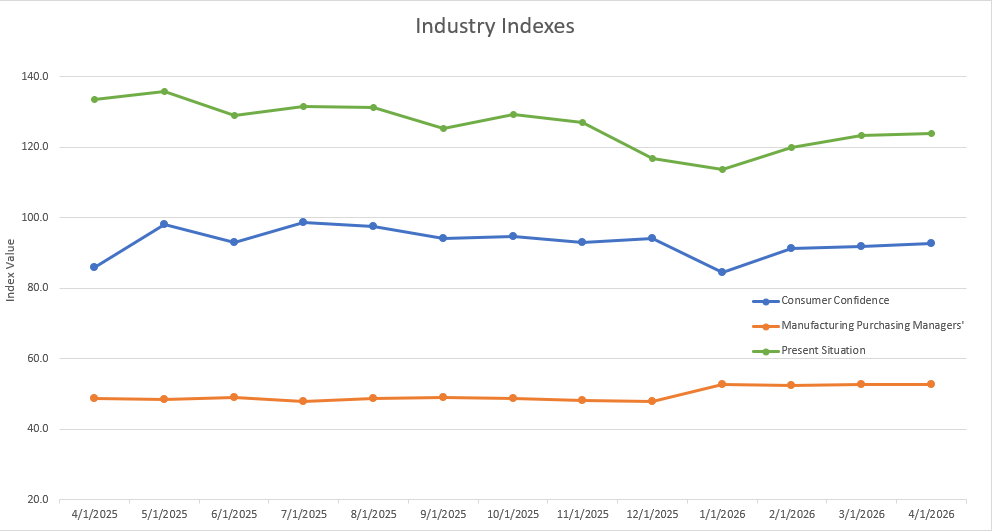
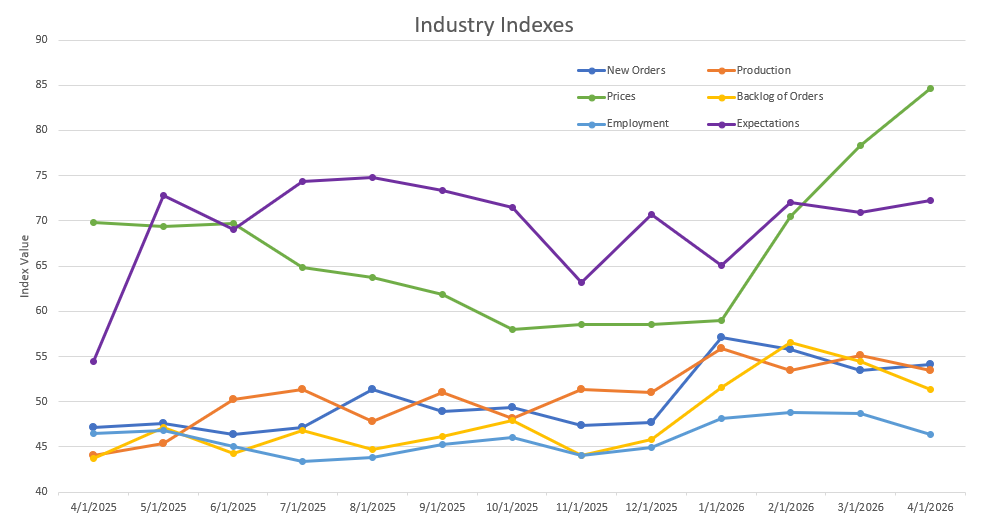
Economic activity in the manufacturing sector expanded in April for the fourth consecutive month, say the nation’s supply executives in the latest ISM® Manufacturing PMI® Report.
The Manufacturing PMI® registered 52.7 percent in April, the same reading as March. The overall economy continued in expansion for the 18th month in a row. (Important data point reference: A Manufacturing PMI reading above 50 percent indicates that the manufacturing economy is generally expanding; below 50 percent indicates that it is generally declining. A Manufacturing PMI above 42.5 percent, over a period of time, indicates that the overall economy, or gross domestic product (GDP), is generally expanding; below 42.5 percent, it is generally declining. The distance from 50 percent or 42.5 percent is indicative of the extent of the expansion or decline.)
The Conference Board Consumer Confidence Index® edged up by 0.6 points to 92.8 (1985=100) in April, from 92.2 in March’s upwardly revised reading.
Please see the graphs for other notable indexes related to our industry.
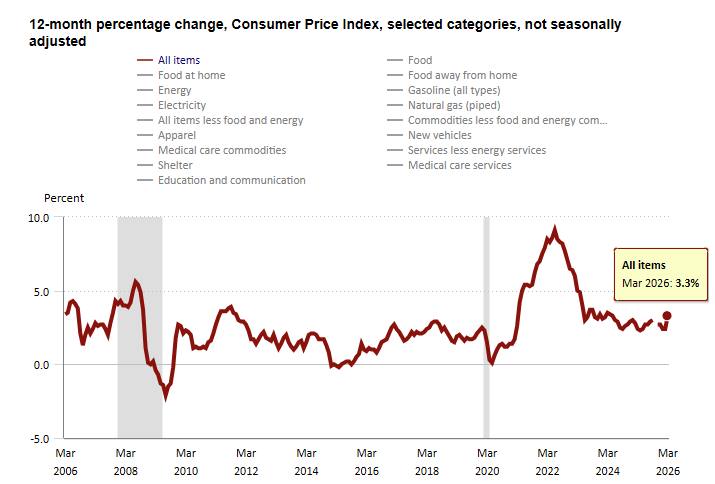
The Consumer Price Index (CPI, otherwise known as our “inflation” friend) is currently at 3.8% in April 2026, up from 3.3% in March 2026 and up from 2.4% in February 2026. CPI tracks the rate of change in US inflation over time, and the following shows the trends over the past 20 years. This is the highest annual increase since May 2023 with energy costs being the big driver of this bump.
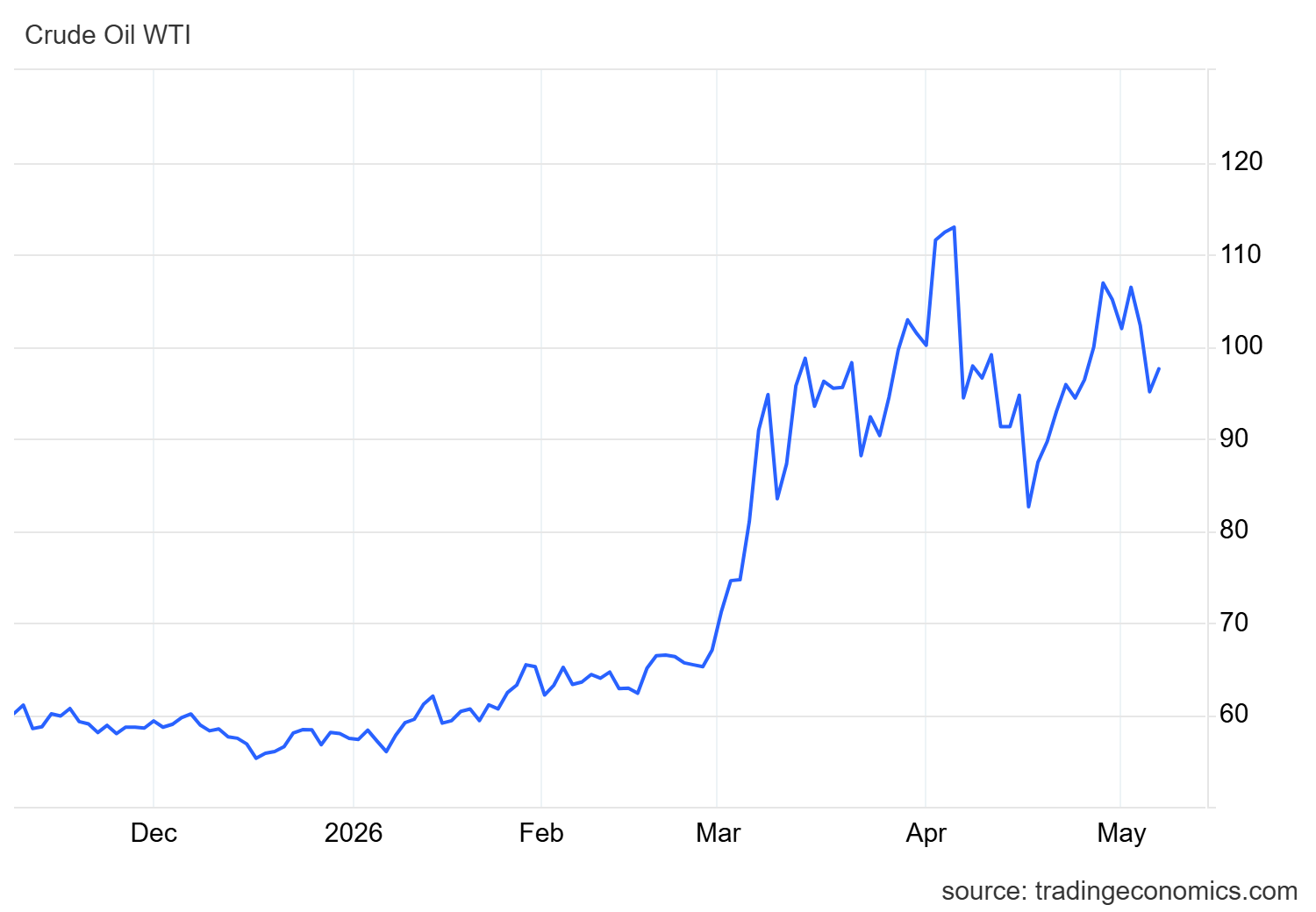
WTI crude oil futures erased sharp losses to $96 per barrel on Thursday as markets continued to wait for clarity on potential supply from the Persian Gulf. Iran was still reviewing the memorandum sent by the US to end their two-month war, which would include the gradual resumption of tanker flows from the Middle East. President Trump had signaled optimism on Iran agreeing to the concessions, which drove oil and refined product prices to plunge last session. Still, the pullback was limited as global oil supply is expected to remain muted even if restrictions in the Strait of Hormuz are lifted. Resumption of production capacity in GCC states is due to be slow due to damage and insurers are reluctant to service tankers crossing the Strait following reports of strikes in the region. The halt in exports from the key region drove the US to deplete its product stocks, with gasoline inventories dropping for 12 consecutive weeks, while those for distillate fuel fell for nine weeks.
The online US Oil Rig Count is currently reported as 547, which is down 1 compared to last month’s report and down 37 from April 04, 2025. This key and leading indicator shows the current demand for products used in drilling, completing, producing, and processing hydrocarbons, which we all use every day as fuel sources and finished products.
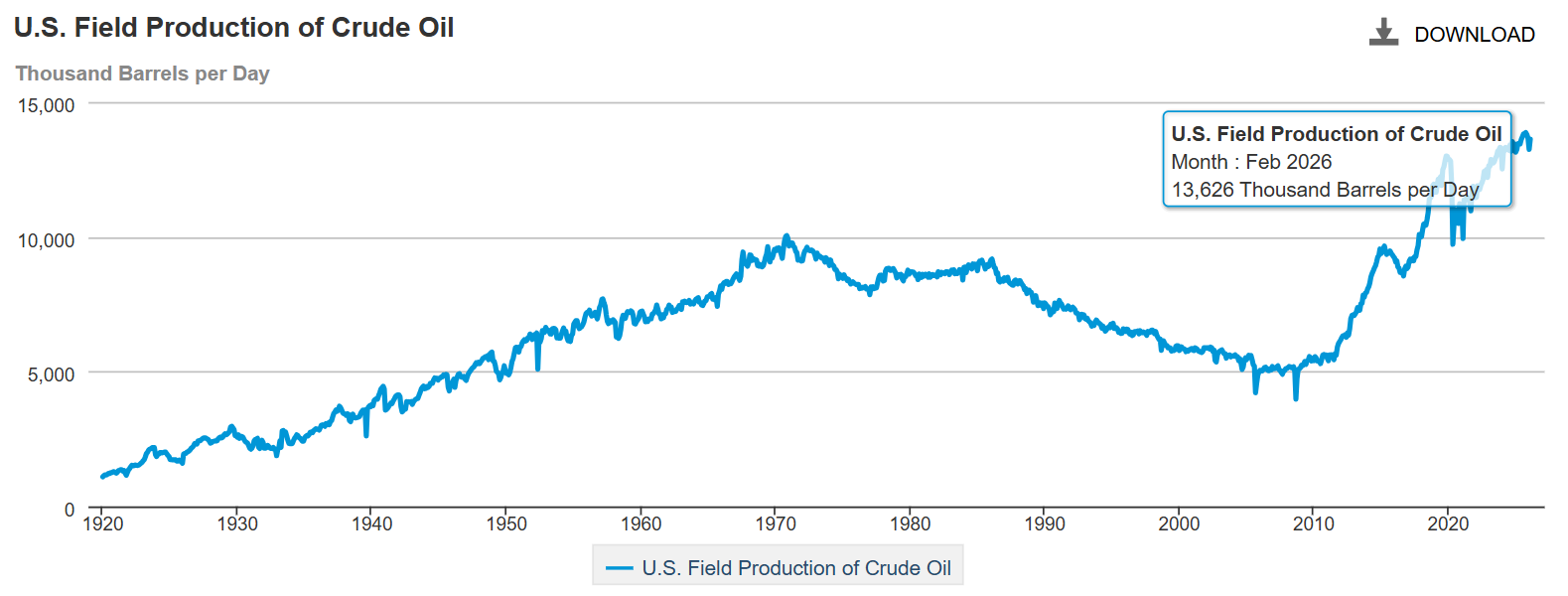
The number of rigs conducting oil and gas drilling in the United States remains stagnant, but efficiency has increased significantly over the years, as shown in the chart below. We are drilling at or near record production levels. However, this trend of fewer rigs still reflects the priority of drillers to focus on efficiency and enhancing shareholder returns rather than expanding production through capital investments due to the previous administration’s desire to move away from fossil fuels. This philosophy might change now that the Trump administration is entirely behind fossil fuels. To provide context, in 2019, 954 rigs were drilling for oil and gas in the US, and, in 2014, there were 1609 rigs before oil prices dropped below $20 per barrel at the end of that year.
Tariffs have tightened, untightened, and will continue to evolve as the Trump administration navigates global negotiations.
Whew… There’s still A LOT to unpack here, so hold on for the roller coaster ride.
A little background on where all of this started and what it means. Tariffs are duties placed on foreign goods, paid by domestic importers to Customs and Border Protection at ports of entry. President Trump introduced tariffs on select Chinese goods in his first term back in 2018, which President Joe Biden later maintained, along with duties on steel and aluminum from most countries. In February of 2025, Trump reinstated tariffs—10% more on Chinese imports, bringing them to 35%, and 25% on Mexican and Canadian goods (except for oil, taxed at 10%). From there, it has been an ever-changing environment with tariffs going up and down from month to month based upon negotiations with other nations.
Tariff update for May 2026
A lot has happened in the courts over the last 90 days. Here is where things stand as of May 2026 and what it means for you.
The Section 122 Ruling
On May 7th, the U.S. Court of International Trade issued a 2-1 ruling that the Trump administration’s 10% across-the-board global tariff, imposed under Section 122 of the Trade Act of 1974, was unlawful. The court found that the administration’s justification did not meet the statutory requirement of a “large and serious balance-of-payments deficit.” Trade deficits, the court said, are not the same thing as balance-of-payments deficits. That is an important legal distinction, and the court drew a hard line on it.
The ruling currently applies only to the named plaintiffs. It does not establish a nationwide injunction. The administration is expected to appeal. And critically, Section 122 tariffs were already scheduled to expire on July 24, 2026, making this more of a legal signal than a market-moving event.
That signal matters. This is the second major court rebuke of broad executive tariff authority in 2026. The Supreme Court struck down IEEPA tariffs in February. The Court of International Trade struck down Section 122 tariffs in May. The courts are drawing clear lines. The power to tax is Congress’s power. Period.
Section 232
None of the above pertains to Section 232, which governs tariffs on steel, aluminum, and copper. It was written specifically to authorize tariff action on national security grounds. It has survived every legal challenge to date and remains fully in effect.
The April 6th framework remains the operative structure:
- Raw mill products, plate, sheet, tube, pipe, and fittings at 50% on the full customs value.
- Derivative articles substantially made of steel, aluminum, or copper at 25% on full customs value.
- Certain metal-intensive industrial equipment at a temporary 15% through December 31, 2027.
- Products made with 100% U.S.-origin metal at 10%.
- Products with 15% or less metal content by weight are not subject to Section 232 tariffs.
How Does This Affect Imported Pressure Vessels and Heat Exchangers?
Per our understanding, pressure vessels and heat exchangers are fabricated equipment classified under HTS Chapter 84 (industrial machinery), not Chapters 72 through 76 (raw steel mill products). This distinction matters significantly under the April 6th Section 232 overhaul.
For aluminum heat exchangers, the picture is clear. HTS subheadings 8419.50.10 and 8419.50.50 are explicitly listed as aluminum derivative articles in the April 6th proclamation, meaning imported finished aluminum heat exchangers are subject to a 25% tariff on the full customs value of the unit, not just the metal content. On a $500,000 imported aluminum heat exchanger, the tariff base is the full $500,000.
For stainless steel, alloy, and carbon steel heat exchangers, and for pressure vessels of any material, the situation is less settled. These products typically classify under HTS 8419.50.50 and 8419.89, respectively, neither of which appears in the steel derivatives section of the April 6th annexes. This creates a genuine gray area. Imported finished steel heat exchangers and pressure vessels may not currently be explicitly covered by the Section 232 derivative tariff on the finished unit.
It is also worth noting what the Annex language does and does not say about tanks and vessels under Chapter 73. Two codes are listed under Annex I-A at the 50% rate. HTS 7309.00.00 covers iron or steel reservoirs, tanks, vats, and similar containers with a capacity exceeding 300 liters, but only those not fitted with mechanical or thermal equipment. HTS 7311.00.00 covers iron or steel containers for compressed or liquefied gas.
While these codes may appear to cover pressure vessels at first glance, the critical limitation in 7309 is that phrase: “not fitted with mechanical or thermal equipment.” A fabricated ASME pressure vessel with nozzles, instrumentation, internals, and process connections would almost certainly not qualify under that language. Neither code uses the word “vessel” at all. A purpose-engineered ASME Code vessel is fundamentally different from a simple storage tank or container. The customs classification of fabricated pressure equipment under Chapter 73 versus Chapter 84 is a fact-specific determination, and Chapter 84 typically governs process equipment of this nature.
What is unambiguous for all product types is that the raw material inputs (i.e. stainless plate, carbon steel plate, seamless and welded tubing, and pipe fittings) are covered at the full 50% rate under Annex I-A, regardless of how the finished equipment is ultimately classified.
One Process Change Worth Noting.
The petition-based inclusion process that previously allowed domestic manufacturers and trade associations to formally request that specific HTS codes be added to Section 232 scope has been terminated. Going forward, Commerce and USTR will adjust product coverage on a rolling basis at their own discretion. There is no formal submission window anymore.
That means if you believe imported finished pressure vessels and heat exchangers should be explicitly covered under Section 232 derivative tariffs, the path forward is direct engagement with your elected officials. Not a petition. A phone call. A meeting. A letter.
As pressure vessel and heat exchanger fabricators, we need to continue pushing for protection to be in place for manufacturers of steel products, not just for domestic suppliers of raw material. We encourage every customer and partner in this industry to make that contact.
What This Means for Ward.
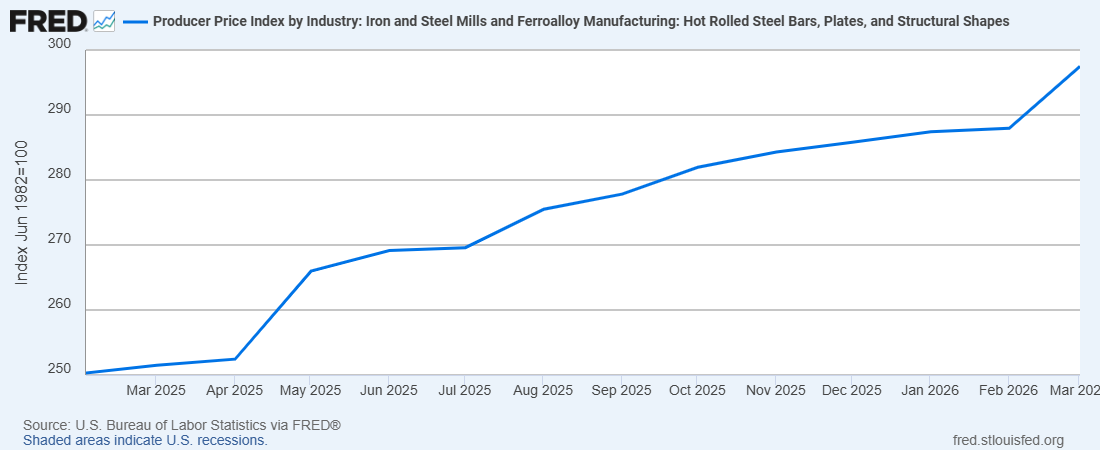
Nothing changes in our cost structure today. We purchase 80 to 90 percent of our material domestically depending on the project. Our total material spend has increased approximately 10 to 20 percent since Section 232 tariffs were enacted, resulting in a 5 to 15 percent overall unit price increase after labor. We are absorbing what we can. We are passing through what we must. And we will continue to monitor the evolving situation and update you each month on the latest developments.
The administration has published several tariff fact sheets on the White House website (click here) as the tariff topic has evolved.
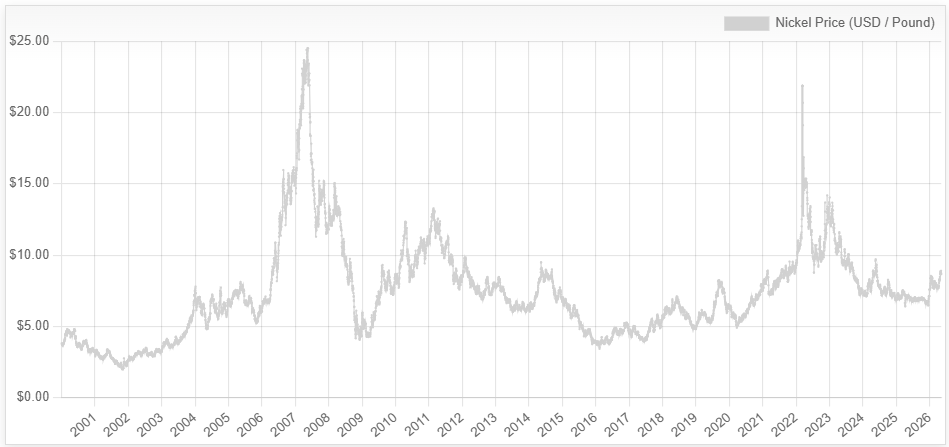
Nickel futures traded around $8.686 per pound, easing from a recent over two-year high near $8.890, as profit-taking emerged after the recent sharp rally. Traders began locking in gains as the market digested the speed of the move rather than any deterioration in underlying fundamentals. Broader industrial metals also showed mixed price action, reflecting a pause in risk appetite after a strong run across the base metals complex. The earlier rally had been driven by tightening supply narratives and Indonesia-linked policy signals, including expectations of higher export-related costs and windfall taxes that reinforced a higher cost floor for the nickel industry. Sentiment was also supported by elevated official reference prices and strong momentum in refined nickel contracts, which had pulled the broader complex higher. Meanwhile, nickel remains underpinned by a tight supply backdrop and a structurally supportive policy environment in Indonesia.
Plate mill plate lead times (weeks):
Domestic:
Stainless & Duplex: 10 to 11 (no change)
Nickel Alloys: 9 to 14 (previously 8 to 15)
Carbon steel: 9 to 13 (previously 6 to 8)
*Keep in mind, some plates will exceed the estimated ranges depending on the mill’s production schedule and slab availability. *
Welded tubing lead times (weeks):
Domestic:
Carbon: 6 to 16 (no change)
Stainless: 8 to 18 (previously 8 to 15)
Nickel Alloy: 8 to 18 (no change)
Import:
Carbon: 14 to 25 (no change)
Stainless: 16 to 30 (no change)
Nickel Alloy: 16 to 42 (no change)
Seamless tubing lead times (weeks):
Domestic:
Carbon: 6 to 26 (no change)
Stainless: 8 to 26 (no change)
Nickel Alloy: 8 to 18 (no change)
*Lead times are accurate if bar is in stock. If not, lead times can increase to 44 weeks as most bars are of foreign melt. *
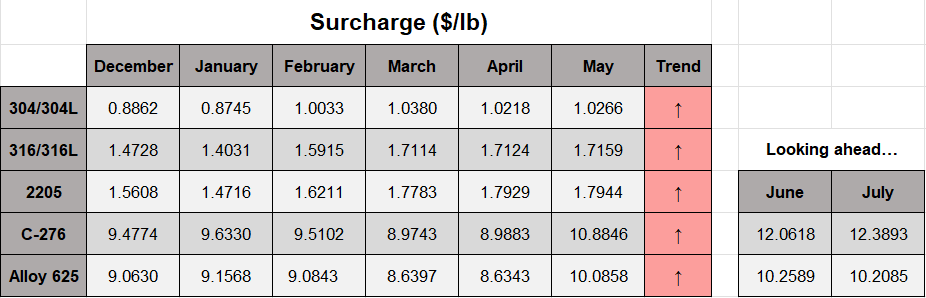
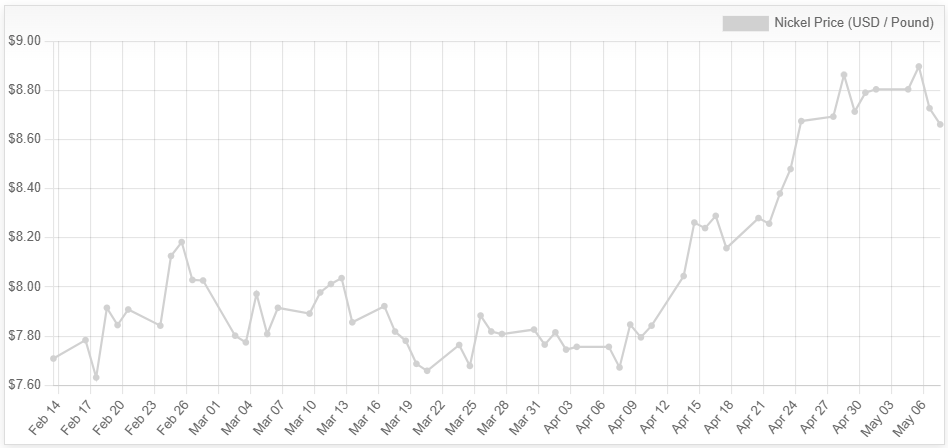
Nickel Prices have had an interesting ride over the past three decades, with a low of $2.20/lb. in October 2001 (following the September 11 events) and a high of $23.72/lb. in May 2007. Surcharges trail Nickel prices by approximately two months, so they would have been at their lowest in December 2001 (304 was $0.0182/lb.) and peak in July 2007 (304 was $2.2839/lb.).