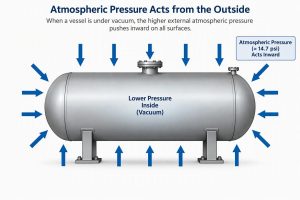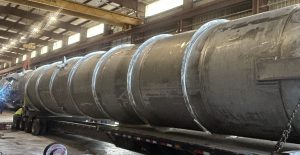

Most pressure vessels are designed for internal pressure, but many will see a vacuum at some point in their service life, sometimes unintentionally. A vacuum inside the vessel means atmospheric pressure is acting on the outside, so the shell and heads must resist up to 15 psi of external pressure. External pressure can cause failure by buckling, and a vessel that is thick enough for a high internal pressure can still fail under a relatively small vacuum. Common causes of a vacuum include steam-out or steam cleaning, where the vessel is blocked in while full of steam and the steam condenses as it cools; draining or pumping out liquid with the vents closed; hot vapors condensing after shutdown; and process upsets such as a sudden cool-down of the contents.
The Code requires each vessel to be designed for all conditions expected in service, and the rules for external pressure design are given in UG-28. However, it is the owner’s responsibility to identify any possible vacuum conditions and include them in the design conditions given to the fabricator. Specifying full vacuum (FV) on new equipment is often a low-cost addition, but on larger or longer shells it may require thicker components or stiffening rings. Vacuum breakers can be used for protection instead, but they must be properly sized and maintained to be effective. When a vessel is rated for external pressure, the rating is shown on the nameplate.